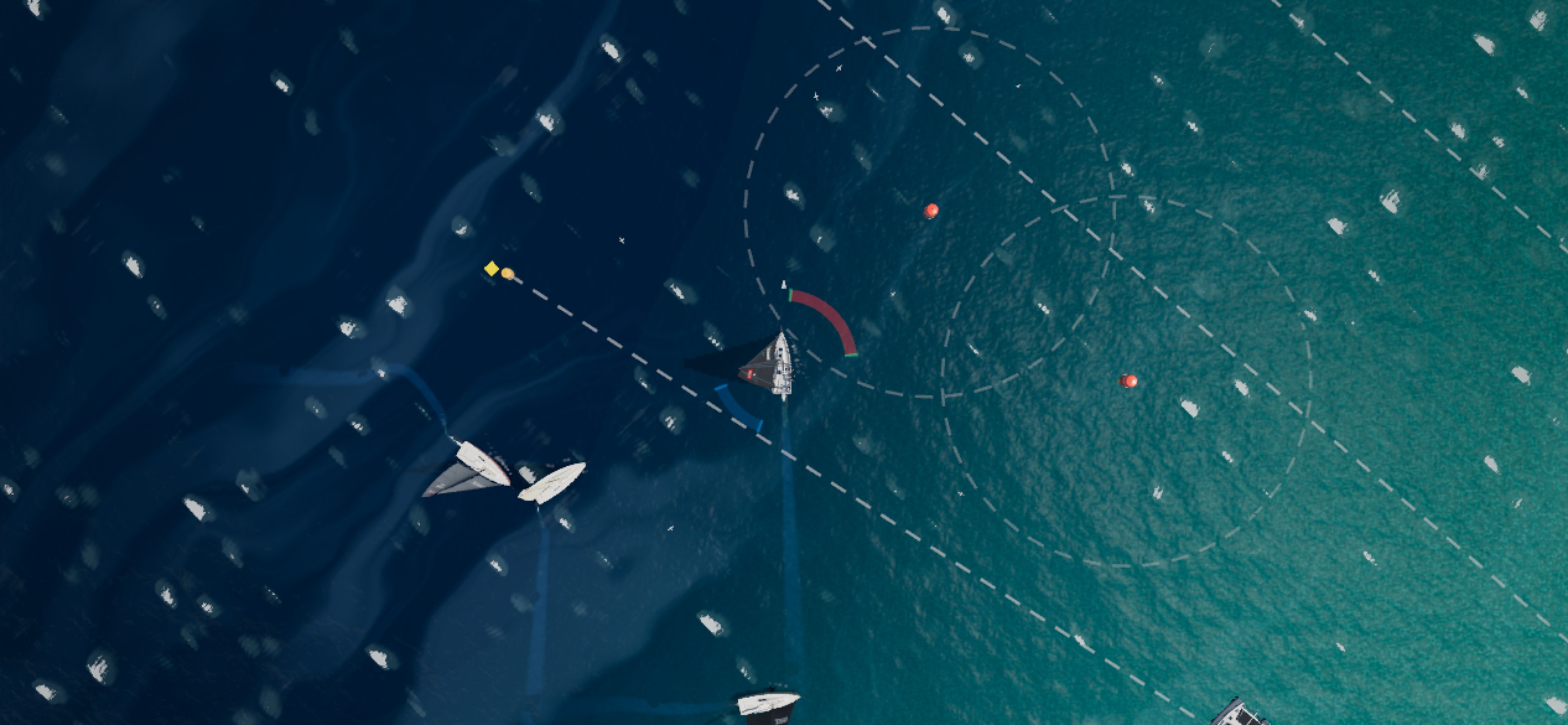
Come in on starboard
The windward mark is usually left to port, so the last tack into it is on starboard, and a starboard boat has right of way over anyone coming in on port (rule 10). Coming in on port means ducking the starboard boats or tacking under them in the zone — where you must not make a boat that has been on starboard since entering the zone sail above close-hauled (rule 18.3).
Don’t overstand: tack onto the layline late enough that a shift can’t leave you sailing extra distance, but early enough not to be stuck below it in a crowd.
Coming in on port in a crowd? Duck the starboard boats and tack onto the layline behind them, outside the zone, rather than in front of them inside it.
The bear-away
Round close to the mark, then bear away smoothly onto the run, easing the sheets as you turn, and hoist the gennaker once you are clear and pointing down the course. Hoisting takes the crew a few seconds, so don’t ask for it in the middle of the turn.
Round half a boat length off the mark: close enough to lose nothing, far enough that a wave or a late turn won’t put you on it, and into a penalty turn.
Pick a side of the gate
At the bottom of the run, a gate gives you two marks to choose from: sail between them and round either one. Take the one further upwind, which shortens the next beat, or the one that sends you towards the side of the course you want — and the one with fewer boats queuing for it.
Drop the gennaker a few lengths before the mark, so the crew is ready to trim upwind as you round.
Pick your gate mark a good few lengths before the zone, so you can swing wide for it. A late change of mind means a tight turn and coming out wide.
Wide in, tight out
Approach a leeward mark a little wide and turn so that you leave it close, already close-hauled. A boat that cuts in tight comes out wide and below the boats behind her, in their dirty air.
Room in the zone
When the first of two overlapped boats reaches the zone, three hull lengths from the mark, the outside boat must give the inside one room to round (rule 18). Get the inside overlap before the zone; an overlap made inside it doesn’t count if you came from clear astern. Between boats on opposite tacks on a beat, at the windward mark, rule 18 doesn’t apply.
Touch a mark and you take a penalty turn (rule 31) — in the game, one turn through a tack and a gybe.
Outside at a leeward mark? Rather than sail round her, slow down, drop in behind her and round tight: you come out to windward of her, in clear air.